Key Specs
Build Volume250×250×300mm
Nozzle Temp480°C
Chamber Temp200°C
Platform Temp200°C
Pricing
$11,999
Authorized CreatBot reseller. Rev1 delivers a complete proposal within 1 business day.
World's First 200°C Desktop Chamber 480°C Water-Cooled Nozzle Direct Annealing — DAS Patent PEEK · PEI · PEKK · PEEK-CF
CREATBOT HIGH-TEMPERATURE FDM

PEEK-250

The world's first desktop 3D printer with a 200°C active heated chamber — built exclusively for PEEK, PEI ULTEM, PEKK, and ultra-performance polymers.
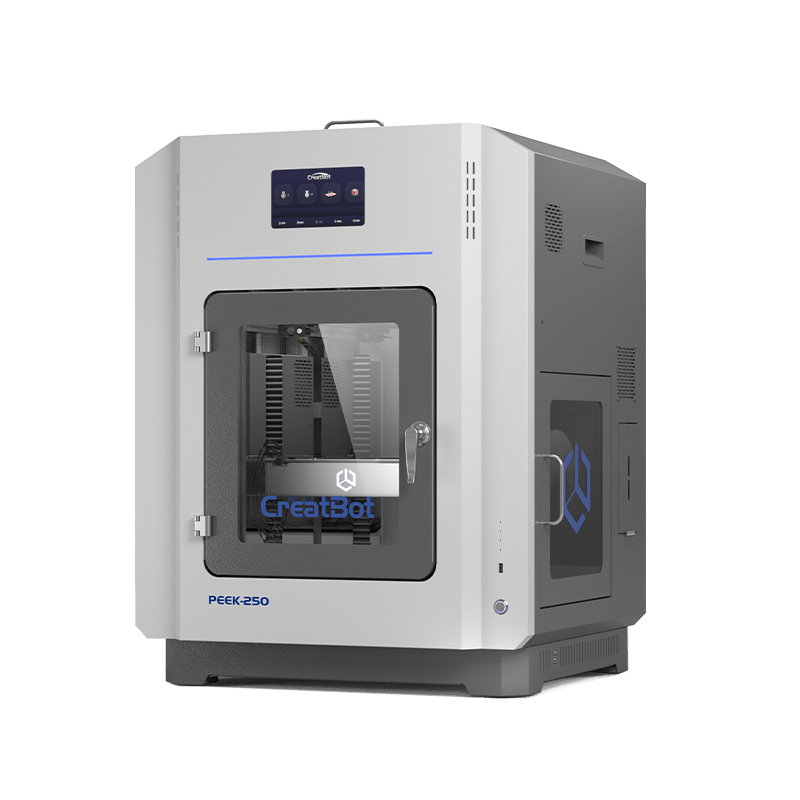
CreatBot PEEK-250 High-Temperature Industrial 3D Printer
/ month · OAC
Flexible business financing for qualified buyers. 72-month term · competitive rates.
Authorized Partner
CreatBot Certified
In-Person Demo
Your Shop or Ours
Fast Shipping
US Warehouse
Free 3D Scan Sample
Send Us Your Part
Install + Training
In the U.S.A.
Why Choose the PEEK-250

The Only Desktop Printer
That Runs at 200°C.

Every other desktop high-temperature 3D printer tops out at 90–120°C chamber temperature. The PEEK-250 reaches 200°C — the threshold where PEEK crystallizes properly, PEI prints without warping, and PEKK achieves full mechanical properties. This is not an incremental upgrade. It is a different class of machine.
200°C
Active Chamber Temp
World's first desktop FDM printer to reach 200°C inside the build chamber — required for proper PEEK crystallization and PEI bonding. Heats to 180°C in under 20 minutes.
480°C
Nozzle Temperature
Water-cooled direct drive with silicon carbide double-tooth extruder. Handles PEEK, PEEK-CF, PEKK, PEI 1010, PEI 9085, and all engineering polymers below 500°C.
DAS
Direct Annealing System
Patented technology. Anneal PEEK and PEI parts directly in the printer after printing — no separate furnace, no thermal shock, no warping during post-processing.
Water-Cooled Extruder
Active liquid cooling keeps the drive mechanism below thermal limits while the hotend runs at 480°C — the only way to maintain consistent extrusion at extreme temperatures without stepper motor failure.
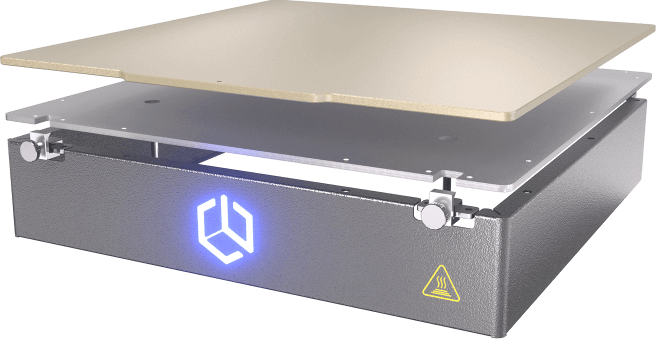
Aviation-Grade Platform
PCB aluminum + PEEK print board rated to 200°C. Natural flatness 0.05mm, high-temperature flatness 0.1mm at 180°C chamber — no manual leveling required, eliminating sensor failure risk at extreme temperatures.
Safe External Surface
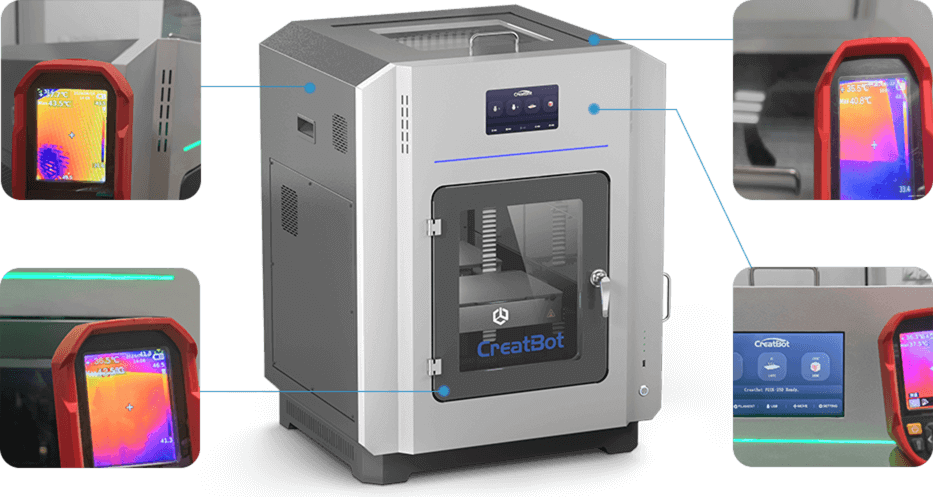
Aviation-grade multi-layer thermal insulation keeps the external chassis below 40°C even after 5+ hours at 180°C chamber — safe for standard lab and production floor environments without additional enclosures.
360° Spoiler Circulation
A patented spoiler device circulates hot air uniformly throughout the chamber in all directions — eliminating thermal gradients that cause uneven crystallization, warping, and mechanical property variation between part faces.
30-Second Nozzle Swap
Integrated die-casting wear-resistant nozzle design — replaceable in under 30 seconds without removing any screws or disassembling other components. Critical for switching between abrasive PEEK-CF and standard PEEK material runs.
7-Inch Full-Color Touch UI
Multi-language 7-inch touchscreen with real-time temperature monitoring for nozzle, platform, and chamber independently. Direct annealing schedule programming — set post-print anneal cycles directly on screen before starting the job.
200°C Active Heated Chamber

Why Chamber Temperature
Is Everything for PEEK.

PEEK requires a 160–200°C ambient environment during printing for complete crystallization, interlayer bonding strength, and dimensional stability. Below this threshold, parts exhibit internal stress, micro-cracking, and reduced mechanical properties — regardless of how precise the nozzle temperature is.
Ultra-High Temperature Extruder
Silicon Carbide.
Water-Cooled. 480°C.
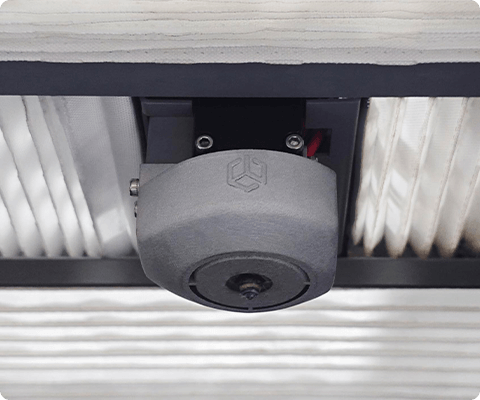
The PEEK-250 uses a double-tooth silicon carbide extruder with active water cooling — the only reliable way to drive high-temperature filament through a 480°C hotend without heat creep destroying print quality or motor reliability.

The silicon carbide drive teeth provide extreme wear resistance for abrasive materials including PEEK-CF and PEKK, maintaining consistent grip torque over thousands of print hours without degradation that steel teeth exhibit with carbon-filled polymers.
Silicon Carbide DriveWater Cooling480°C RatedPEEK-CF Safe
CreatBot PEEK-250 ultra-high temperature extruder system
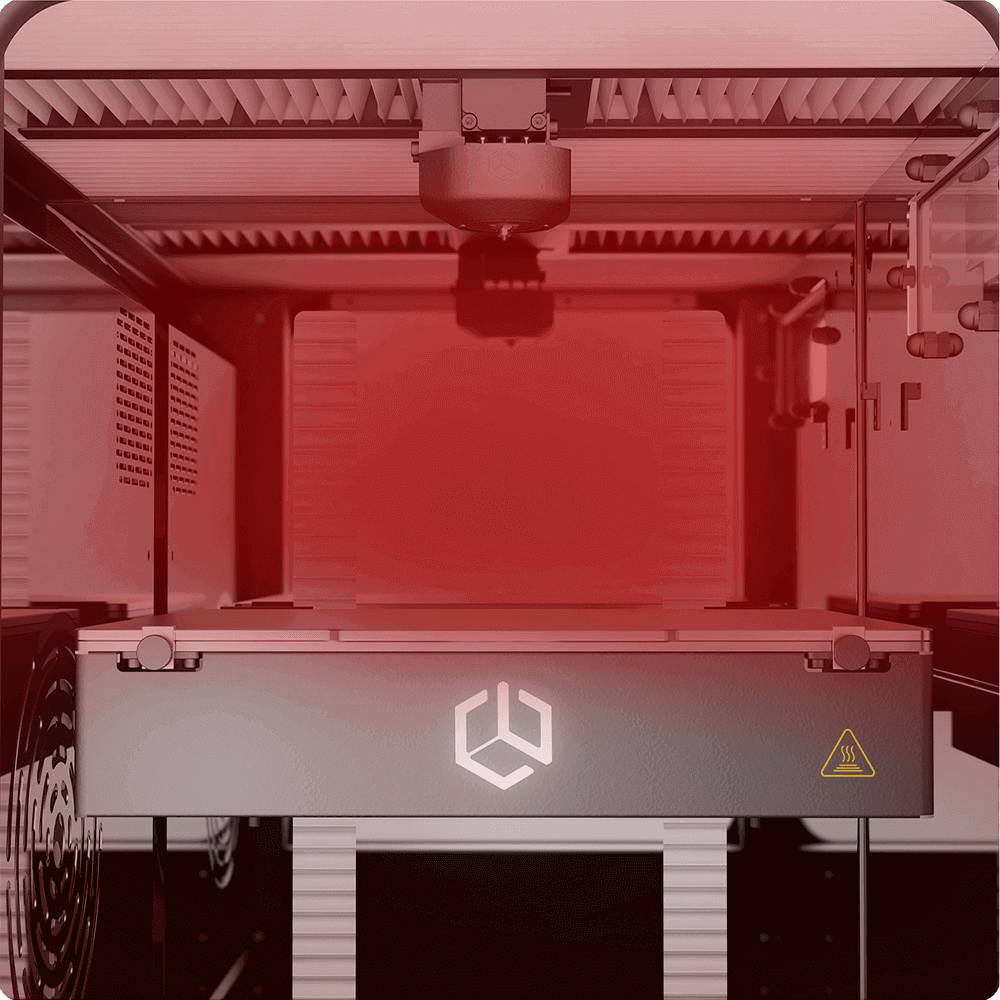
CreatBot PEEK-250 200°C active heated chamber interior
200°C Thermally Uniform Chamber
360° Hot Air Circulation.
Uniform Crystallization.
The PEEK-250's patented spoiler device circulates hot air through the chamber in all directions simultaneously — the glowing chamber interior shown here reaches a fully uniform 200°C with no hot spots or cold zones.

PEEK printed in a non-uniform chamber develops inconsistent mechanical properties between the top and bottom surfaces of a part. The PEEK-250 eliminates this variable entirely. Every part crystallizes uniformly at any angle, in any position in the build volume.
360° Spoiler CirculationUniform Crystallization180°C in 20 min200°C Max
Chamber Temperature vs Part Quality
Same Part. Same Settings.
Different Chamber Temp.
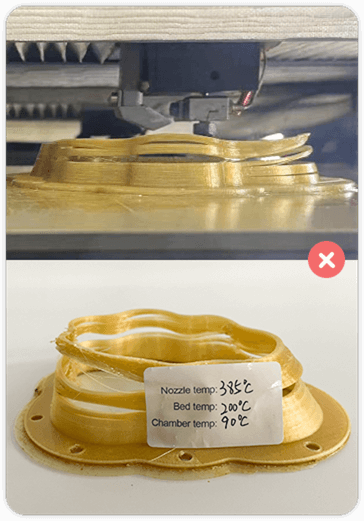
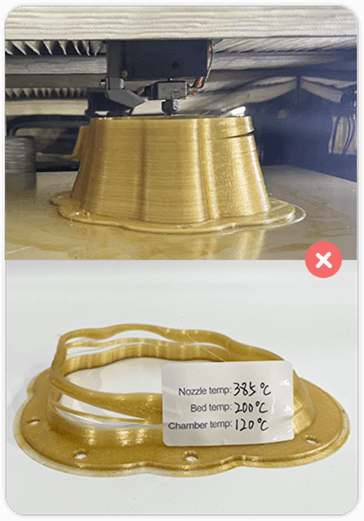
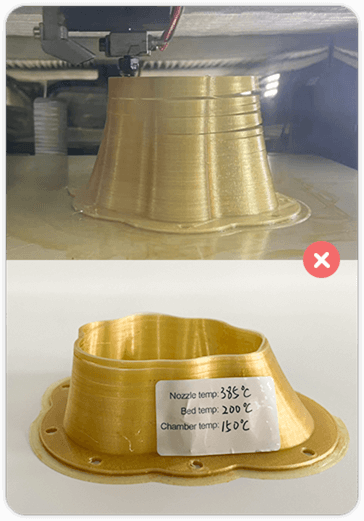
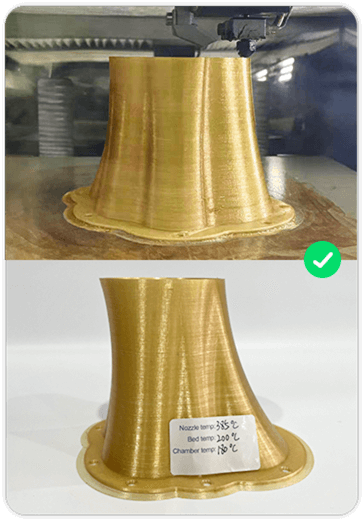
These four prints use identical G-code, nozzle temperature, and print speed. The only variable is chamber temperature. At 90°C — the maximum for most competing desktop PEEK printers — the part shows visible surface delamination, layer separation, and stress fracturing. At 180°C, the part achieves full PEEK crystallization with consistent surface quality from base to tip.

This is why the PEEK-250's 200°C chamber is not a spec checkbox. It is the difference between a PEEK-shaped object and a PEEK part.
90°C → Delamination120°C → Partial Bond150°C → Near Complete180°C → Full Crystallization
PEEK part at 90°C chamber — delamination
90°C — Fail
PEEK part at 120°C chamber
120°C — Partial
PEEK part at 150°C chamber
150°C — Near
PEEK part at 180°C chamber — full crystallization
180°C ✓ Full
CreatBot PEEK-250 three-layer aviation thermal insulation — cool exterior at 200°C chamber
Thermal Safety — Aviation-Grade Insulation
200°C Inside.
Under 40°C Outside.
The PEEK-250 uses three layers of aviation-grade thermal insulation combined with active air cooling. When the chamber hits 180°C, the front door, top panel, screen area, and side panels all remain below 40°C — safe to touch after 5+ continuous hours of operation.

No external safety enclosure required. No restricted access zone. The machine runs safely on a standard production floor or lab bench.
3-Layer Aviation InsulationExterior <40°CActive Air CoolingLab Safe
Direct Annealing System — DAS Patent

Print. Anneal. Done.
No Separate Furnace.

Every other approach to PEEK post-processing requires removing the part from the platform, cooling it, and placing it in a separate annealing furnace — introducing thermal shock that fixes internal stress into the part permanently. The PEEK-250's patented DAS solves this at the hardware level.
Why Separate Annealing Fails
Thermal Shock Locks
Internal Stress In.
When you remove a freshly printed PEEK part and cool it before annealing, three failure modes activate simultaneously. First, platform adhesion loss at the base releases restraint, causing the bottom to deform as internal stress redistributes. Second, rapid cooling from print temperature creates a large temperature differential that fixes stress gradients into the crystalline structure. Third, transferring to a separate furnace introduces handling stress before the part has stabilized.

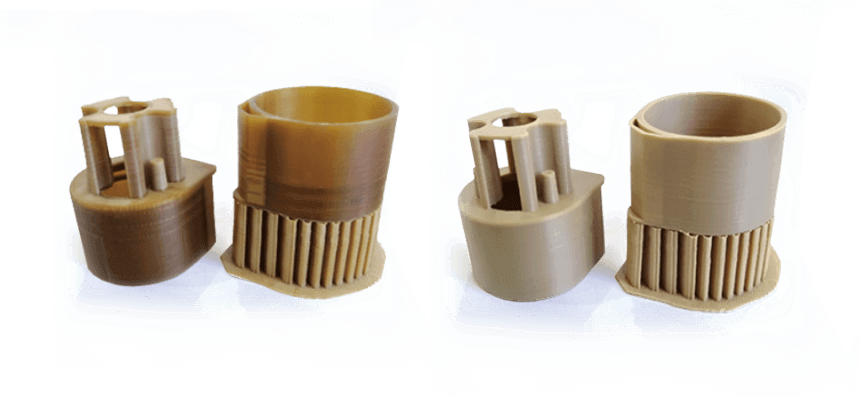
DAS eliminates all three: the part stays on the platform, in the chamber, with a programmable anneal schedule that executes immediately after the final layer — with zero handling and no thermal shock.
No Platform RemovalNo Thermal ShockProgrammable ScheduleOne-Click Anneal
CreatBot PEEK-250 DAS annealed PEEK parts — single and dual extrusion output
CreatBot PEEK-250 aviation-grade 200°C flat build platform
Aviation-Grade 200°C Platform
No Manual Leveling.
Ever.
The PEEK-250 uses an aviation-grade PCB aluminum base with PEEK print board — naturally flat to 0.05mm at room temperature, maintaining 0.1mm flatness at 180°C chamber temperature after thermal expansion. No manual leveling. No auto-leveling sensor that will fail at 200°C. No drift over thermal cycles.

The platform is rated for continuous operation at 200°C with the polymer-based coating maintaining adhesion for PEEK, PEI, and PEKK throughout the print and anneal cycle without adhesive sprays or release agents.
PCB Aluminum + PEEK Board200°C Rated0.05mm Natural FlatnessNo Leveling Required
Compatible Materials

From Engineering Polymers
to Ultra-Performance Grade.

The PEEK-250's 480°C nozzle, 200°C chamber, and water-cooled extruder unlock the full range of high-performance thermoplastics — from standard engineering materials through aerospace and medical-grade ultra-performance polymers that no other desktop printer can process reliably.
Ultra-Performance
PEEK
Polyether ether ketone. Highest strength-to-weight ratio in FDM. Chemical resistant to virtually all solvents. Continuous service temperature 250°C. Medical and aerospace primary material.
Nozzle: 400–430°C · Chamber: 160–200°C · Bed: 120–160°C
Ultra-Performance
PEEK-CF
Carbon fiber reinforced PEEK. Stiffness increased 30–40% over unfilled PEEK. Reduced weight, improved dimensional stability. Requires silicon carbide extruder for reliable long-term use.
Nozzle: 410–440°C · Chamber: 160–200°C · Bed: 120–160°C
Ultra-Performance
PEI (ULTEM™)
PEI 1010 and PEI 9085. High-temperature amorphous polymer with inherent flame retardancy. FAA-approved for aircraft interiors (9085). Medical sterilization compatible. Requires 200°C chamber for optimal results.
Nozzle: 360–400°C · Chamber: 160–200°C · Bed: 160–200°C
Ultra-Performance
PEKK
Polyether ketone ketone. Higher crystallinity rate than PEEK enables faster processing. Superior chemical resistance and mechanical performance. Used in aerospace structural components and medical implants.
Nozzle: 350–380°C · Chamber: 160–200°C · Bed: 120–180°C
High-Performance
PEEK-GF
Glass fiber reinforced PEEK. Improved stiffness and reduced thermal expansion vs unfilled PEEK. Lower cost than PEEK-CF with similar dimensional stability improvements. Electrical insulation maintained.
Nozzle: 400–430°C · Chamber: 160–200°C · Bed: 120–160°C
High-Performance
PPSU
Polyphenylsulfone. Superior chemical and hydrolytic stability vs standard PSU. Autoclave sterilizable to 134°C. Used for surgical instruments, fluid handling components, and high-temperature structural parts.
Nozzle: 380–420°C · Chamber: 120–180°C · Bed: 160°C
Engineering
UltraPA-CF / PA-CF
Carbon fiber reinforced polyamide. Excellent strength-to-weight for tooling and fixtures. High fatigue resistance. Broad temperature range — the PEEK-250 runs these with full chamber control for optimal interlayer bonding.
Nozzle: 260–300°C · Chamber: 60–80°C · Bed: 80–100°C
Engineering
PC · ABS · ASA · PETG
Standard engineering polymers fully supported. The PEEK-250's chamber temperature control enables better results with standard materials than a standard printer — crystallinity and bonding benefits apply across all thermoplastics.
Nozzle: 240–280°C · Chamber: 40–70°C · Bed: 80–110°C
Printed on the PEEK-250
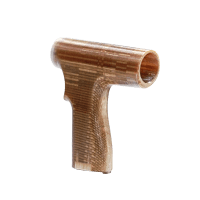
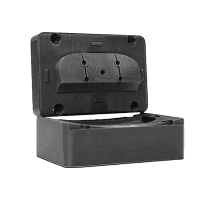
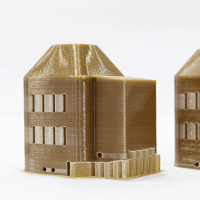
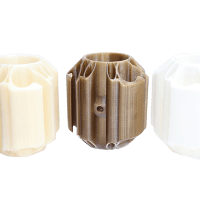
Real parts — PEEK, PEI, and PEKK. Single and dual extrusion.
PEEK printed lattice structure
PEEK printed part
PEEK printed part
PEEK printed architectural model
PEEK printed cylindrical parts
Industries Served

Built for Where Material
Performance Cannot Fail.

PEEK, PEI, and PEKK are specified in environments where standard engineering polymers fail — extreme heat, chemical exposure, autoclave sterilization, FAA compliance, and prolonged mechanical loading. The PEEK-250 puts these materials in reach of any production facility.
Medical & Implantable
PEEK is the primary polymer for patient-specific spinal implants, cranial plates, and orthopedic trial components. The PEEK-250 produces sterile-field compatible parts with autoclave resistance and biocompatibility. Rev1 works directly with medical device teams on material validation and print protocol development.
Aerospace & Defense
PEI 9085 is FAA-approved for aircraft interior components. PEEK structural brackets survive sustained 250°C service in proximity to engines and avionics. PEKK is specified for satellite components. The PEEK-250 provides a qualified production path for these materials in-house.
Semiconductor & Electronics
PEEK is the standard material for wafer handling equipment, chemical delivery components, and vacuum-compatible fixtures. Its dimensional stability under thermal cycling and resistance to semiconductor process chemicals make it irreplaceable in fab environments.
Oil & Gas
PEEK and PPSU resist hydrocarbon solvents, steam, and H2S at elevated pressures and temperatures. Downhole tool components, valve seats, and seal housings that would degrade in standard engineering polymers run reliably in PEEK for years of continuous service.
Automotive & EV
High-temperature underhood components, battery management system housings, and transmission components that require sustained performance above 150°C where PLA, ABS, and even nylon fail. The PEEK-250 enables in-house production of these parts without outsourcing lead times.
Research & Academia
Universities, national labs, and R&D facilities use the PEEK-250 for material science research, novel polymer development, and small-batch specialized component production. The direct annealing system enables controlled crystallization studies not possible on any other desktop platform.
Technical Specifications

CreatBot PEEK-250 —
Full Data Sheet.

Build Volume
250 × 250 × 300 mm
Filament Diameter
1.75mm
Number of Nozzles
Single Extruder (dual-extrusion mode supported)
Nozzle Diameter
0.4mm standard · 0.6mm optional
Nozzle Max Temp
480°C
Chamber Temp
200°C max (180°C in 20 min)
Platform Max Temp
200°C
Platform Surface
PCB aluminum + PEEK print board
Best Print Speed
55 mm/s
Max Print Speed
180 mm/s
XY Positioning
±0.0127mm
Z Positioning
±0.00125mm
Extruder Type
Direct drive — double-tooth silicon carbide
Cooling System
Air pump + water cooling (extruder)
Thermal Insulation
3-layer aviation-grade · exterior <40°C at 180°C chamber
Annealing
Direct Annealing System (DAS) — patented
Screen
7-inch full-color touch · multi-language
Connectivity
USB · USB Disk · WiFi
Slicer Software
CreatWare · Simplify3D · Cura · Slic3r
Rated Power
2500W · 200–240V · 20A
Machine Size
630 × 555 × 815mm
Machine Weight
120kg
Documentation & Resources

Everything You Need
to Start Printing.

📄
User Manual
PEEK-250 complete operation and maintenance guide — English. Covers setup, PEEK/PEI material profiles, DAS annealing configuration, and troubleshooting.
Download PDF →
💾
CreatWare Slicer
Official CreatBot slicer for Windows and macOS. Pre-configured material profiles for PEEK, PEI, PEKK, and PEEK-CF. Also compatible with Simplify3D, Cura, and Slic3r.
Download Software →
🔧
Accessories Toolkit
Enhanced accessories documentation including nozzle specifications, silicon carbide extruder maintenance schedule, water cooling system service, and chamber calibration procedures.
Download Toolkit →
What's Included

PEEK-250 — Everything
in the Box.

PEEK-250 Printer
Fully assembled, calibrated, and tested. Includes water cooling system pre-filled and pressure tested.
0.4mm Nozzle (installed)
Silicon carbide wear-resistant nozzle — rated for PEEK-CF and all abrasive polymers. Replaceable in 30 seconds.
PEEK Print Board
Aviation-grade PEEK polymer build surface — pre-installed on PCB aluminum platform. Rated to 200°C continuous.
Power Cable
240V industrial power cable. A 20A dedicated circuit is required — Rev1 will confirm electrical requirements at site assessment.
USB Drive
Pre-loaded with PEEK, PEI, and PEKK material profiles for CreatWare. Includes sample G-code test prints for each material tier.
Tool Kit
Nozzle removal tool, platform cleaning supplies, water cooling service kit, and spare hardware. All tools required for standard maintenance included.
User Manual
Full printed English user manual. Includes DAS annealing programming guide and material-specific recommended profiles for all supported polymers.
Rev1 Onboarding
Rev1 includes delivery coordination, on-site setup, water cooling system verification, material profile configuration, and operator training in the purchase.
Competitive Analysis

How the PEEK-250
Stacks Up.

Compared against the leading desktop high-temperature FDM platforms — the Intamsys Funmat HT and the Apium P400. The PEEK-250's 200°C chamber is the defining differentiator in this category.
CreatBot PEEK-250 Intamsys Funmat HT Apium P400
Starting Price~$11,999~$7,000+~$50,000+
Chamber Temperature200°C Active90°C150°C+
Nozzle Temperature480°C450°C540°C
Platform Temperature200°C160°C200°C
Direct Annealing (DAS)✓ Patented✗ None✗ None
Water-Cooled Extruder✓ Included✗ Air only✓ Yes
Build Volume250×250×300mm260×260×260mm205×160×145mm
PEI (ULTEM) Support✓ Full lineLimited (90°C chamber)✓ Yes
SlicerCreatWare · Cura · S3D · Slic3rIntamsuite (proprietary)Apium (proprietary)
Machine Weight120kg~68kg~200kg
Competitor specifications sourced from manufacturer published data. Pricing based on publicly available list pricing. Intamsys Funmat HT and Apium P400 are trademarks of their respective owners.
Why Buy from Rev1

Authorized. Deployed.
Supported. In the USA.

YOUR REV1 PARTNER
AUTHORIZED CREATBOT RESELLER
Rev1 Technologies is an authorized CreatBot reseller serving manufacturers, research institutions, and medical device companies across the USA. The PEEK-250 requires site preparation, water cooling verification, and material-specific commissioning — Rev1 handles all of it, on-site, before we consider your machine live.
01
Site Assessment First
The PEEK-250 requires a 240V/20A dedicated circuit, floor rated for 120kg, and adequate ventilation. Rev1 reviews your facility before shipment to ensure day-one readiness — no surprises on delivery day.
02
On-Site Installation
Rev1 coordinates freight delivery, positions the machine, verifies the water cooling system pressure and flow, calibrates the platform, and runs commissioning prints in your target material before leaving.
03
Material Validation
Rev1 will print your actual PEEK or PEI part before purchase — free sample print. Send us your STL and material requirement; we'll print it and ship it to you so you can validate quality before committing.
04
Operator Training
Full training for your team on DAS annealing programming, material profile configuration, water cooling maintenance, and nozzle replacement. Rev1 stays until your team is printing confidently.
05
Ongoing US Support
Rev1 provides domestic technical support for the PEEK-250 — no waiting for overseas response cycles on a machine that runs 24/7 production of critical parts. (248) 707-2950.
06
Financing Available
Rev1 works with industrial lending partners offering 72-month equipment loans and operating leases. At approximately $211/month OAC, the PEEK-250 is accessible for labs and production facilities of any size.
Common Questions

Frequently Asked —
CreatBot PEEK-250.

What materials can the PEEK-250 print that other desktop printers cannot?
The PEEK-250's 200°C active heated chamber is the key differentiator. Most desktop high-temperature printers max out at 90–120°C chamber temperature — enough for ABS and basic nylon, but insufficient for PEEK, PEI ULTEM, or PEKK. These ultra-performance polymers require a 160–200°C ambient environment during printing to crystallize properly and achieve full mechanical properties. Below this temperature, the same materials print but exhibit internal stress, micro-cracking, and significantly reduced strength, chemical resistance, and heat deflection. The PEEK-250's 200°C chamber, combined with a 480°C water-cooled extruder and Direct Annealing System, enables production-quality PEEK, PEI 1010, PEI 9085, PEKK, PEEK-CF, and PEEK-GF that no other desktop platform can achieve.
What is the Direct Annealing System (DAS) and why does it matter?
DAS is CreatBot's patented system for annealing printed parts directly inside the printer immediately after the final layer, without removing the part from the platform. Traditional PEEK post-processing requires cooling the part, removing it from the platform, and placing it in a separate furnace — each step introducing thermal shock and handling stress that can deform the part or lock internal stress into the crystalline structure. DAS eliminates all three failure modes: the part remains on the platform, in the controlled chamber environment, while a programmable anneal schedule executes automatically. You set the anneal temperature and duration on the 7-inch touchscreen before starting the print — the printer handles everything from first layer to fully annealed part with no intervention. For PEEK, a typical DAS schedule is 180°C for 5 hours, then 120°C for 5 hours before cooling.
What facility requirements does the PEEK-250 need?
The PEEK-250 requires a dedicated 240V / 20A electrical circuit at 2500W rated capacity. The machine weighs 120kg and measures 630×555×815mm — a standard concrete floor is sufficient, no special reinforcement needed. The three-layer aviation-grade thermal insulation keeps the exterior below 40°C even at maximum chamber temperature, so a standard lab or production environment does not require additional ventilation or a heat-isolated room. WiFi connectivity requires standard 2.4GHz access. Rev1 conducts a facility assessment before shipment to confirm all requirements are met and to identify any site preparation needed before the machine arrives.
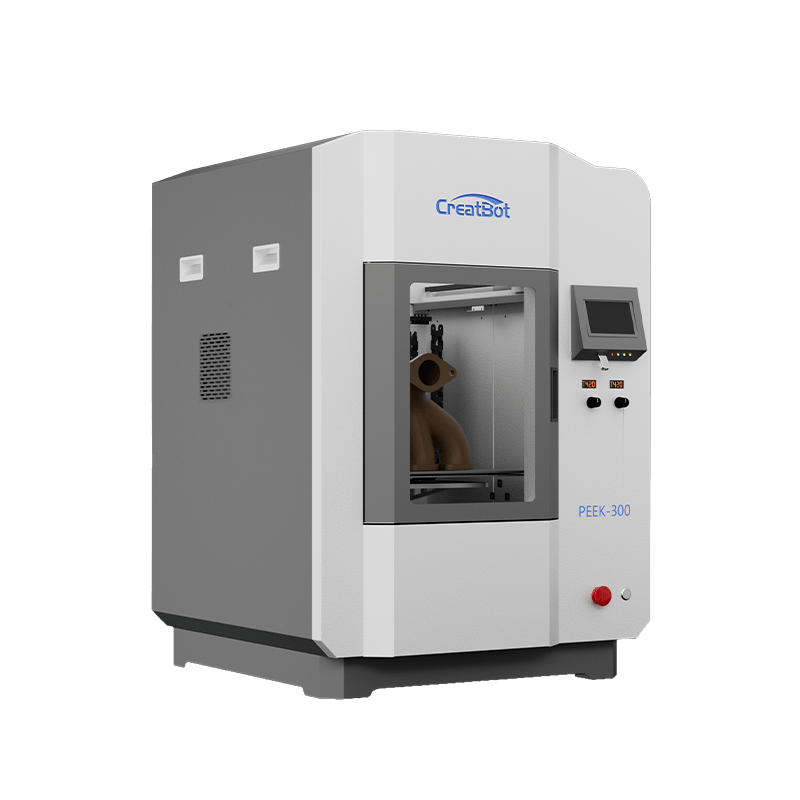
How does the PEEK-250 compare to the PEEK-300?
The PEEK-250 and PEEK-300 share the same 480°C nozzle and 200°C platform rating but differ in two critical areas: build volume and chamber temperature. The PEEK-250 has a 250×250×300mm build volume and a 200°C maximum chamber — the highest in any desktop PEEK printer. The PEEK-300 offers a larger 300×300×400mm build volume (60% more build space) but runs a 120°C maximum chamber temperature. For parts requiring the hottest possible chamber — specifically complex PEEK crystallization and PEI ULTEM at full mechanical performance — the PEEK-250 is the correct choice. For larger parts where the 120°C chamber is sufficient for the material, the PEEK-300 provides more build volume. Rev1 can advise on the right platform for your specific application and material requirements.
Can the PEEK-250 print standard engineering materials like ABS, nylon, and PC?
Yes — the PEEK-250 supports the full range of engineering polymers including PLA, ABS, ASA, PC, PETG, nylon, PVDF, UltraPA, UltraPA-CF, and PET-CF. For these materials, the chamber temperature is simply set lower (40–80°C range), and the machine operates as a standard high-performance FDM printer. The benefit of running engineering materials in the PEEK-250 is that the chamber temperature control is far more precise than in a passively heated or unheated enclosure — parts in ABS and nylon print with better interlayer bonding and less warping than in a standard printer. Most PEEK-250 customers use the machine for both their ultra-performance polymer work and their routine engineering polymer production, maximizing utilization of the machine throughout the week.
How does the CreatBot PEEK-250 compare to the Intamsys Funmat HT?
The Intamsys Funmat HT is priced lower at approximately $7,000 and is a legitimate entry point for PEEK printing, but it maxes out at 90°C chamber temperature — less than half the PEEK-250's 200°C. At 90°C, PEEK parts print but do not achieve full crystallinity, resulting in reduced tensile strength, lower heat deflection temperature, and higher susceptibility to chemical attack vs properly crystallized PEEK. The Funmat HT also lacks water cooling on the extruder and has no direct annealing system, meaning post-processing requires a separate furnace. For customers who need production-quality fully crystallized PEEK and PEI ULTEM parts with the highest mechanical properties, the PEEK-250's 200°C chamber, water-cooled extruder, and DAS justify the additional cost. For lower-priority PEEK work or research applications where full crystallinity is not required, the Funmat HT is a cost-effective option — Rev1 can help determine which platform fits your application.
Ready to Evaluate the PEEK-250?
Get Your
PEEK-250
Quote Today

Talk to a Rev1 PEEK specialist. We'll review your parts, validate material requirements, and determine whether the PEEK-250 or PEEK-300 is the right fit. Free sample print available — send your STL and we'll print it in PEEK or PEI and ship it to you. Authorized CreatBot Partner · Auburn Hills, MI · (248) 707-2950.

(248) 707-2950(248) 707-2950Auburn Hills, MI
Get Pricing
Ready to bring PEEK printing in-house?
Rev1 builds complete solutions — printer, PEEK materials, installation, and application support. Request a quote and we'll respond within 1 business day.
Ready to Print PEEK In-House?
Get Your
PEEK-250
Quote Today

Talk to a Rev1 Technologies expert. We'll qualify your PEEK application, validate your material requirements, and build a complete solution — machine, filament, setup, and ongoing support. Auburn Hills, MI.
Auburn Hills, Michigan's premier source for industrial 3D printers, 3D scanners, materials, and software. Serving engineers and manufacturers across North America.

Products
Company
Contact
Payment methods
American ExpressApple PayGoogle PayMastercardPayPalShop PayUnionPayVisa
Pay over time

© 2026 Rev1 Technologies. All rights reserved.